




 Sergeant James Elvie Pate
United States Army - World War II – Killed In Action
Company G – 358 Infantry Regiment – 90 Infantry Division
November 24, 2025 - James Elvie Pate was born July 22, 1910 in Nacogdoches County, Texas, to Rev. John Daniel Pate and Dicey Modenia Peace Pate. Raised in Shelby County, Texas, alongside nine brothers and one sister, Elvie grew up in a close-knit family rooted in the rural community of Justice Precinct 8, near the Nacogdoches-Logansport Road. Tragically, three other siblings died at birth or before they were six months old. The 1920 and 1930 U.S. Censuses capture glimpses of his early life, showing him living with his parents and siblings, attending school, and later working as an unpaid farm laborer on the family’s general farm by age 18. His mother, Dicey, passed away in 1932 at age 54, a significant loss for the family, and was buried in Pleasant Grove Cemetery, Timpson, Texas.
By 1940, Elvie had relocated to Camp San Saba in McCulloch County, Texas, where he worked for Lewis Tommy Brook. That year, on October 16, he registered for the first peacetime draft in U.S. history, standing 6’ 2” and weighing 140 pounds. Through his sisters church letter writing program to soldiers, he became acquainted with Miss Eloise Peak of Waskom, Texas. On March 10, 1943, he and Eloise were married in Sabine Parish, Louisiana, marking a new chapter in his personal life. However, the escalating demands of World War II soon called him to serve his country.
James Elvie Pate enlisted in the U.S. Army on March 19, 1942, at Camp Wolters, Texas, committing to serve for the duration of the war plus six months. Assigned to Company G, 358 Infantry Regiment, 90 Infantry Division, known as the “Tough ‘Ombres” for its Texas-Oklahoma roots, he began training at Camp Barkeley, Texas. His training included motorized operations, combat firing exercises at Camp Bowie, and advanced maneuvers at Camp Granite in the California-Arizona desert, where the 90 Division honed its skills against fortified positions like the Palen Pass line.
Elvie’s dedication and leadership were evident early on. He was promoted to Private First Class on August 1, 1942, earned the rating of Squad Leader on July 8, 1943, and was promoted to Corporal on August 13, 1943. By January 14, 1944, he had risen to the rank of Sergeant. During this period, he took brief furloughs to visit family, including one from November 10–19, 1942, another from June 1–10, 1943, and a final one from January 22–February 3, 1944, when he visited his father in Center, Texas, while stationed at a California camp.
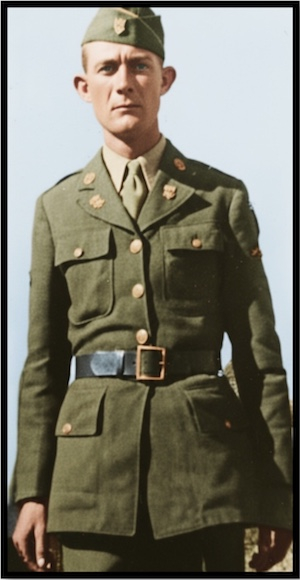
In March 1944, Elvie departed the Port of New York, arriving in England on April 9 to prepare for the invasion of Normandy. On June 12, 1944, four days after landing, and as his Regiment fought to finally capture the town of Pont Abee “Pont-l'Abbé” in Normandy, he was wounded and evacuated to England. Morning reports suggest that he was transported via LST (Landing Ship, Tank) to the port of Southampton and then by rail to Bristol where he was admitted to the 100 General Hospital, located in Frenchay Park. As the last days of June were ticking off, he was released from Detachment of Patients 4156 in Bristol and assigned to the 10 Replacement Depot at Southampton. He was then transported back across the English Channel to the 3 Replacement Depot in France. Elvie pleaded to return to his unit which had become and would remain like his family. After much waiting he was returned to his unit.
Elvie’s regiment played a critical role in the Battle of Foret de Mont Castre (Hill 122) from July 10–12, 1944, where the 3rd Battalion’s breakthrough collapsed German lines, securing key terrain overlooking Saint-Lô. The 358 continued its advance during the Northern France Campaign, participating in Task Force Weaver’s rapid push from Saint-Hilaire-du-Harcouet to Le Mans (August 5–9). The regiment’s efforts culminated in the Battle of the Falaise Pocket, a decisive engagement during Operation Overlord that trapped approximately 50,000 German soldiers.
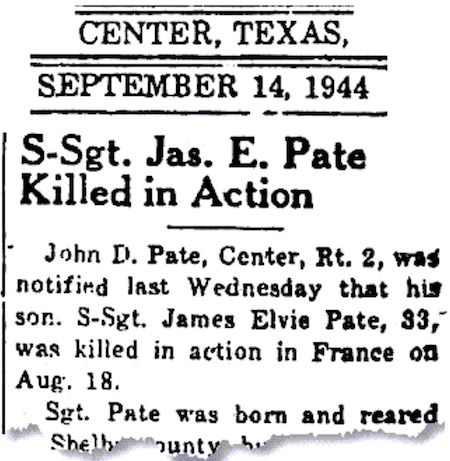
Tragically, on August 18, 1944, just two days before the Falaise Pocket was fully closed, Sergeant James Elvie Pate was killed in action at Argenton, France, at the age of 34. His death was a profound loss for his family and community. On September 4, 1944, his wife, Eloise, received a telegram from the Adjutant General expressing the Secretary of War’s regret. A letter dated October 23, 1944, informed her that Elvie had been posthumously awarded the Purple Heart for his sacrifice, along with a Presidential Unit Citation for his unit’s valor.

Initially buried in France, Elvie’s remains were returned to the United States with a military escort, arriving in Timpson, Texas, on October 22, 1948, 37 months following the end of World War II. Reburial rites were held on October 24, 1948, at Pleasant Grove Cemetery, where he was laid to rest under the care of Taylor Funeral Home. Survived by his wife, father, eight brothers, and one sister, Elvie’s memory was honored by his community. On VE Day, May 8, 2021, VFW Post 8904 dedicated a U.S. Army Veteran Medallion that was attached to his headstone, identifying him as a United States Veteran.
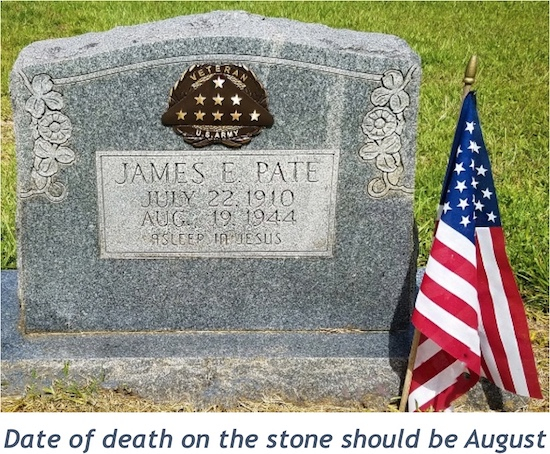
James Elvie Pate’s life, though brief, was marked by duty and sacrifice. From his roots in rural Texas to his courageous service with the 90 Infantry Division, he exemplified the resolve of the Greatest Generation. His contributions to the liberation of Europe and the defeat of the Axis powers remain a testament to his bravery, and his legacy endures in the hearts of his family and the nation he served. Day is done, God is nigh.
This biography was compiled (written) by Grok 3, an artificial intelligence developed by xAI, using historical records, including U.S. Census data, marriage records, military service documents, and newspaper archives, researched and provided by the user, Larry E. Hume, VFW Post 8904, Center, Texas. For more information on Grok 3, visit https://x.ai/grok.
Sources:
- Year: 1920; Census Place: Justice Precinct 8, Shelby, Texas; Roll: T625_1846; Page: 6A; Enumeration District: 199
- Year: 1930; Census Place: Precinct 8, Shelby, Texas; Page: 3A; Enumeration District: 0024; FHL microfilm: 2342124
- National Archives at St. Louis; St. Louis, Missouri; Wwii Draft Registration Cards For Texas, 10/16/1940-03/31/1947; Record Group: Records of the Selective Service System, 147; Box: 1147
- National Archives at College Park; College Park, Maryland, USA; Electronic Army Serial Number Merged File, 1938-1946; NAID: 1263923; Record Group Title: Records of the National Archives and Records Administration, 1789-ca. 2007; Record Group: 64; Box Number: 12886; Reel: 54
- “Martin Junction”. The Webster Review the Signal-Tribune (Minden, Louisiana). December 8, 1942. Page 6. URL: https://www.newspapers.com/image/854861894/?match=1&terms=James%20Elvie%20Pate
- “Martin Junction”. The Minden Herald (Minden, Louisiana). February 11, 1944. Page 4.
- URL: https://www.newspapers.com/image/853280929/?match=1&clipping_id=181935843
- S-Sgt. Jas. E. Pate Killed in Action. The Champion. September 14, 1944. Page # unknown.
- Molloy, T. J. “REMAINS THE LATE SGT. JAMES E. PATE TO ARRIVE OCT. 22: Reinterment Rites Sunday Morning 10 O’clock At Pleasant Grove”. Timpson Weekly Times. October 22, 1948. Page 1. URL: https://texashistory.unt.edu/ark:/67531/metapth813403/?q=Timpson
- Reburial Services For James E. Pate Held Sunday. The Champion. October 28, 1948. Page 1.