



 PFC James W. “Jim” Williams
United States Army, World War I
Company D, 408 Telegraph Battalion, Signal Corps
December 10, 2025 - Jim was born on Thursday, October 22, 1896, just six months after the opening of the first modern Olympic Games in Athens, Greece. His birthplace was the small far east Texas town of Joaquin, which is located in Shelby County. His parents were Jessie and William M. Williams and he is believed to have had five siblings; Laura (1892), Freddie (1897), Verry Arron (1902), Blair (1907), and Maggie (1912). The family lived on a rented farm located on Joaquin and Shelbyville Road in Precinct 4 of Shelby County.
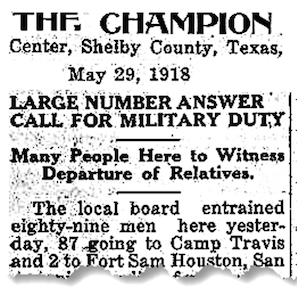
Farm chores were left behind on Tuesday, June 5, 1917, as Jim took time to register for the military draft at Precinct 12. The United States entered the world war on April 7, and this was the first mandatory registration called for by the 1917 Selective Service Act. His registration card (Form 1) noted this information: age as 21; natural-born citizen; self-employed as a farmer; single; Caucasian; no prior military service and no exemption to the draft was claimed. Physically he was described as of medium height and built with blue eyes, light-colored hair and was not bald. He was then assigned draft number 1712.
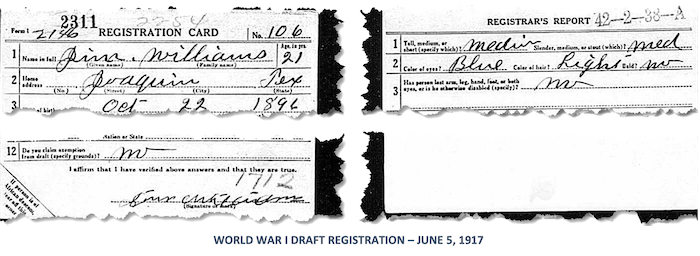
Receiving his draft notice, Jim took the oath of enlistment at the county seat of Center on Monday, May 27, 1918, becoming US Army Private Williams, serial # 6063081. The Champion newspaper, Center, Shelby County, Texas, May 29, 1918 gave this account of the activity that went on. “The local board entrained eighty-nine men here yesterday, 87 going to Camp Travis and 2 to Fort Sam Houston, San Antonio. At the Baptist Church Monday [May 27] afternoon a very large audience assembled to pay tribute to those going away. The services were very impressive and very much appreciated. Rev. C. H. Adams, Rev. F. L. Hall, and Hon. J. P. Anderson made appropriate talks. The Champion has a note this morning from two of the boys going away, asking us to express to the citizens here their appreciation for the splendid treatment during their time here, for the church services, and to those who cared for the ones remaining overnight here. Yesterday morning those going away lined up on Cora St. had their pictures made and then marched to the depot. The Elm Grove band came in and rendered splendid music. Practically every store in town closed and the crowd at the train was the largest that has gone their (sic) to see soldier boys off.” Of the 89 names listed, Calvin Ramey would not survive the war.
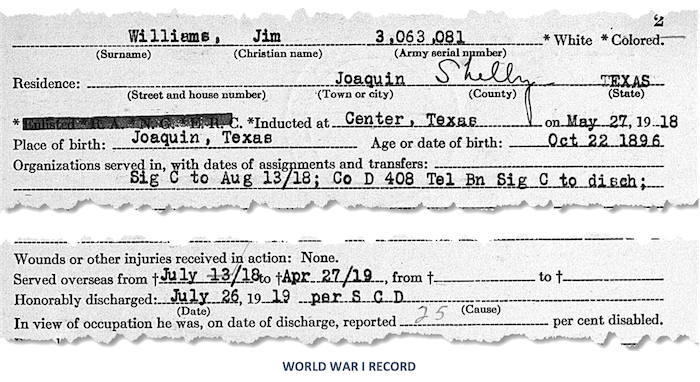
Following basic training at Camp Travis, Jim was assigned to Company D, 408 Telegraph Battalion of the Signal Corps. It is unclear where he may have trained but during the world war, the Signal Corps was responsible for communications and Army ground and aerial photography. The British cargo ship, SS Hemistocles got underway and departed the port of New York on July 15, 1918 with Private Williams and his unit on board, bound for the war in France. His father William was listed as the next of kin on the passenger list to be notified in case of an emergency.
The normal trip took around eleven days via Liverpool, England and it is at this point that Jim’s service with the Signal Corps is not well documented. Major Douglas J. Orsi said in his thesis on the Signal Corps: “The U.S. Army Signal Corps was effective in supporting division-level maneuver units during World War I. Although faced with the enormous challenges of rapid expansion, inadequate organization, as well as new doctrine, training centers, and equipment; the Signal Corps forged ahead. Through the personal courage and initiative of its soldiers, the Signal Corps successfully supported the maneuver units within the AEF infantry divisions. Although much was learned through trial and error, units progressively became more adept at providing command and control communications from the division down to the company level.”
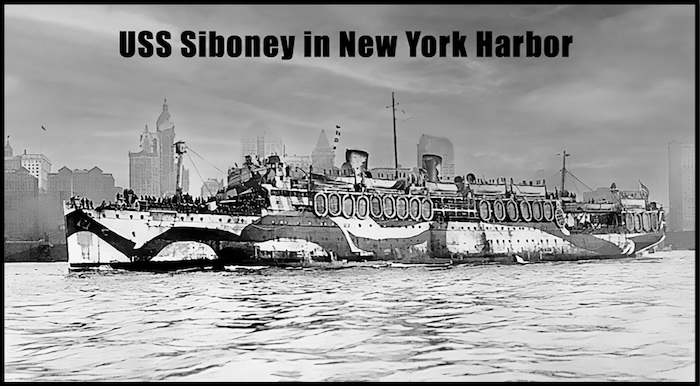
Combat operations and hostilities ceased with the signing of the Armistice on November 11, 1918 which ended the World War. Jim remained in France five more months before orders were received to return to the United States. Although still a member of the 408 Telegraph Battalion, he boarded the Navy Transport USS Siboney with Convalescent Detachment # 254 as a hospital patient with bronchitis. The Siboney was one of seven transport ships that docked in New York on April 27, 1919, bringing home more than 12,000 troops as reported by the Star-Gazette, Elmira, New York, April 28, 1919. Jim undoubtedly was sent to a nearby Army hospital before receiving his honorable discharge three months later on July 26. For his fourteen months of military service, he was awarded the World War I Victory Medal and a twenty-five percent service-connected disability.
Following the war, Jim returned to Shelby County and married Miss Rose Margaret Williams. They would be blessed with two sons, Leon and Carnell. He found work in the Houston, Texas oil fields where they rented a home at 2514 Gentry for twenty dollars a month. After retiring from the oil fields, he died at the age of 70, on May 13, 1965 at the Gulf Coast Medical Center in Wharton, Texas of heart disease. Jim was buried in Woodlawn Cemetery, Houston, Harris County, Texas with his wife Rose who joined him there in 1985. Day is done, God is nigh.
Sources:
(1): Year: 1910; Census Place: Justice Precinct 4, Shelby, Texas; Roll: T624_1588; Page: 4A; Enumeration District: 0150; FHL microfilm: 1375601
(2): Registration State: Texas; Registration County: Shelby County
(3): The National Archives at College Park; College Park, Maryland; Record Group Title: Records of the Office of the Quartermaster General, 1774-1985; Record Group Number: 92; Roll or Box Number: 590
(4): https://www.si.edu/spotlight/women-in-wwi/u-s-army-signal-corps-photos
(5): The National Archives at College Park; College Park, Maryland; Record Group Title: Records of the Office of the Quartermaster General, 1774-1985; Record Group Number: 92; Roll or Box Number: 590
(6): Orsi, Douglas J. Maj, USA. “The Effectiveness of the US Army Signal Corps in Support of the American Expeditionary Force Division and below Maneuver Units During World War I.” US Army Command and General Staff College, 2001.
(7): The National Archives at College Park; College Park, Maryland; Record Group Title: Records of the Office of the Quartermaster General, 1774-1985; Record Group Number: 92; Roll or Box Number: 319
(8): Year: 1940; Census Place: Houston, Harris, Texas; Roll: m-t0627-04192; Page: 10B; Enumeration District: 258-63
(9): Texas Department of State Health Services; Austin Texas, USA