



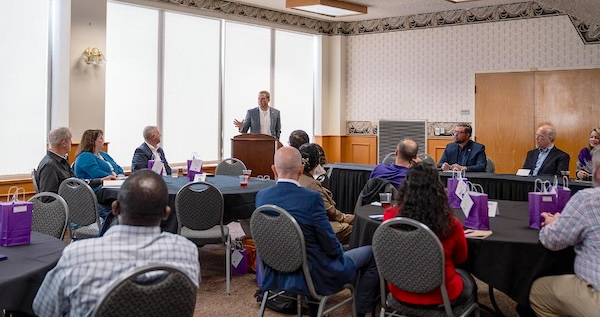
Dr. Drew Gholson, assistant vice president and executive director of Stephen F. Austin State University’s East Texas Water Institute, facilitated discussions between SFA faculty members and representatives from several regional and state organizations at a symposium hosted by the institute and SFA’s Research and Graduate Studies.
November 19, 2026 –– Stephen F. Austin State University’s East Texas Water Institute and Research and Graduate Studies office brought together university researchers and state and regional water agency leaders in November for a symposium focused on East Texas’ water challenges and opportunities for collaboration.
The event provided a forum for agency representatives to share regional needs, identify research opportunities and explore how SFA’s faculty expertise could help develop solutions to pressing water issues.
“We want to introduce you to each other because we know these challenges can’t be solved in isolation,” said Dr. Forrest Lane, dean of Research and Graduate Studies. “We need to work together to figure out how to be smart with the limited resources we have.”
Dr. Drew Gholson, assistant vice president and executive director of the East Texas Water Institute, facilitated the discussion between SFA faculty members and representatives from several regional and state organizations, including Kelley Holcomb, general manager of the Angelina and Neches River Authority; Lonnie Hunt, executive director of the Deep East Texas Council of Governments; Ashley Morgan, SFA alumna and director of the Texas Water Development Board; and Charlie Glover, president and CEO of the T.L.L. Temple Foundation.
“The solutions we need will not be solved in one department,” Gholson said. “We need collaboration among many departments and disciplines.”
Infrastructure remains a critical challenge
Unlike many other regions of Texas, East Texas has an abundant water supply. However, much of the region lacks the infrastructure needed to deliver that water to growing communities and businesses.
“While water is free, building and maintaining the infrastructure is not,” Holcomb said. “That requires raising rates, which upsets the public. We need to educate the public and government officials about water systems and make sure the people running the water systems know what they’re doing.”
Hunt emphasized that East Texas’ water resources could become increasingly vulnerable as population growth and demand place pressure on supplies elsewhere in the state. He noted that the larger metropolitan areas of Houston, Austin, Dallas and San Antonio carry significant influence in the Texas Legislature, creating concerns about the region’s ability to retain control of its water resources.
Agency representatives also discussed the potential impact of Proposition 4, which will dedicate up to $1 billion annually from existing state sales tax revenue to the Texas Water Fund from 2027 through 2047.
While the funding represents an investment in the state's water infrastructure, all the agency representatives said the need far exceeds the available resources.
Hunt pointed to aging and inadequate water lines as a major obstacle to economic development in East Texas. Without reliable infrastructure, communities may struggle to accommodate new residents and businesses.
“If our water supply cannot serve homes and businesses — and we have too many people on 2 miles of 2-inch-diameter pipe — no one will move here and jobs will go somewhere else,” he said.
The region's population trends underscore those concerns. Nine of the 11 Deep East Texas counties experienced population declines or stagnant growth between 2010 and 2020, Hunt said.
“What price is Nacogdoches County willing to pay for not developing its water systems?” Holcomb added.
Workforce development is another pressing concern. Holcomb said approximately 70% of wastewater professionals are expected to age out of the workforce in the coming years, making competitive salaries and training opportunities essential to attracting the next generation of workers.
Research opportunities span multiple disciplines
When Gholson asked agency representatives to identify their most pressing research needs, the responses highlighted opportunities for collaboration across a wide range of academic disciplines.
Requested areas of expertise included asset management, auditing, data collection and analysis, engineering, environmental science, financial modeling, forestry, political science, statistics, wildlife management and workforce training.
Morgan emphasized the value of bringing together fragmented data from organizations such as the Texas Commission on Environmental Quality, the Railroad Commission of Texas, the Texas Department of Licensing and Regulation, and local utility districts. A more comprehensive understanding of available data could help agencies make informed decisions about water resources and infrastructure.
She cited the challenges facing homeowners in areas where local utility systems have reached capacity and cannot accommodate additional connections. In some cases, homeowners are spending more than $20,000 to install private wells, which can create groundwater concerns.
“It would be helpful to have a centralized tool that synthesizes existing data from agencies to provide a better understanding of water resource utilization,” Morgan said.
The discussion also highlighted the importance of making existing research more accessible. In one instance, an agency's requested research had already been conducted and published by an SFA faculty member in an academic journal.
“We need a central repository of academic findings — maybe even a resource within The University of Texas System — that all agencies can access,” Hunt said.
Building a culture of water stewardship
Throughout the symposium, participants returned to a common theme: the need to increase public and government awareness of water as an essential regional resource. Although water infrastructure is fundamental to community growth, it often receives less attention than other priorities, such as energy, roads and data centers.
Glover suggested East Texas could draw inspiration from West Texas, where oil and gas have become central to the region's identity and culture. He said the region could similarly build a shared appreciation for its water resources.
“Can we create an ethos and a culture that we’re water as well as timber?” he asked. “If we create pride in that resource, we can use it as a long-term education and advocacy point.”
Glover said he remains optimistic that many of the region's water challenges can be addressed through research, shared knowledge and sustained collaboration.
“We’re the last water-abundant region in the state of Texas,” he said. “Water is our biggest strength. We have to stop talking about all we have to do and start doing something. SFA has a huge part in that.”
For more information on the East Texas Water Institute, visit sfasu.edu/etwi. To learn more about SFA's Research and Graduate Studies, visit sfasu.edu/orgs.