



November 24, 2025 - Shannon Ramsey may have shared his family's history with the Timpson Area Genealogical and Heritage Society last Wednesday, but when the Ramseys arrived here, there was no Timpson. Shannon's family came to the area in the mid 1850s, when Texas had been a state for only about a decade. “About 1995 or '96 I began a spreadsheet with genealogical information on my computer,” Ramsey began. “It covered only five families and after I had worked on it for a few years, the spreadsheet had grown to about 150 lines. Now, that spreadsheet has grown to over 1500 rows for just my dad's family!”
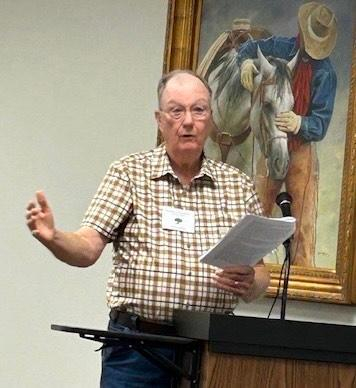
“About 1857, two Ramsey brothers, John Foster Ramsey, and James Marion Ramsey came to Shelby County from Alabama, followed in 1871 by the eldest, George Washington Ramsey. George W. Ramsey was my great-grand uncle and he settled near Bobo but died a few months later. James Marion Ramsey was my great- grandfather. George W. Ramsey's widow, Anna Sparks Ramsey, died in 1878 while visiting my great-grandmother, her sister Cynthia Sparks Ramsey, in the Shady Grove community. She was to have been buried with her husband in the Bradley Springs Cemetery, between Timpson and Tenaha, but that was impossible because the roads were so bad because of recent rains that she became the first person buried in the Shady Grove Cemetery in 1878,” Ramsey revealed.
“John Foster Ramsey was born in Tennessee in 1815 and moved to the Tennessee community in 1857 when he was 42 years old. He died in 1880. His first wife, Mary Williams Ramsey, was killed by a runaway horse not long after they married, so they had no children,” Ramsey said. “He married his second wife in Alabama three years after Mary's death and they had four children, only one of whom survived to adulthood. Following his second wife's death, John Foster Ramsey married Elizabeth Hester in 1847. They had five children and it was she who accompanied John to Texas in 1857.”
“James Marion Ramsey, who was born in Tennessee in 1821 was my great- grandfather. He moved his family to the Shady Grove community, where he is buried, in 1857. He served in Company C of the 6th Texas Infantry during the Civil War. He married Cynthia Sparks Ramsey and they had six children. One of these, William Yancy Ramsey, was my grandfather. One of his brothers, James Pinkney Ramsey was named for James Pinkney who was the first governor of Texas after annexation in 1845. One of his granddaughters was Maude Pinkney, who married Will Rhodes. Will had a sister named Esther, who married Benny Wallace, and they lived on property adjacent to the Rhodes. There was a road that ran through the Rhodes and Wallace properties, a fact that Rhodes and Wallace found objectionable, so, by mutual agreement, they built a fence across both ends of the road on their property lines. This is where my wife Judy and I now live and, to this day, the road dead-ends at our property,” Ramsey said. “There was, however, a driveway that ran from the Timpson-Center highway to our house. My grandfather donated the right-of-way for that driveway to Shelby County and now it is a county road.”
“My grandfather, William 'Yank' Ramsey was born on the property where we live in 1860. He married Nettie Lavada Page in 1888 and they had two children. Sometime before 1900, Yank and Nettie divorced. I have recently learned from my research that Nettie 'run off', leaving Yank with the two children and causing the divorce,” Ramsey revealed. “Aunt Della was born in 1889 and Uncle Alford was born in 1892. In 1906 my grandfather married Esther Queen Pennington, who had been born in Brenham. At the time of their marriage she was 18 and my grandfather was 46. Although he was born in 1860, his tombstone says he died in 1861 and the date of his death is shown as 1938 but he died in 1939. Genealogical researchers should note that the dates on tombstones are not absolute proof of birth and death dates because I have census records which predate the tombstone and conflict with it.”
“Yank and Esther had seven children, six of whom reached adulthood. My father, William Leonard Ramsey, born in 1910, was the second of these children. My grandfather was seventy when the last child was born,” Ramsey shared. “All seven of these children were born in a house that stood on the Ramsey property in Shady Grove. The old house is gone but the well is there. For 156 years, from 1860 to 2016, the people who lived on this property were born on it. When my Uncle Dennard died in 2016, that string was broken. Uncle Dennard was a musician and played steel guitar with the East Texas Playboys in the late 50s and early 60s. My dad married Lennie Cornelia Prince in 1935 but she died in childbirth in 1937. About ten years later, my dad married Marie Nancy Katherine Medley in Lubbock. They had two children, my brother and me. My dad died in 1996 at the age of 86. My brother lives in Amarillo and doesn't like East Texas because 'there are too many trees'. My father was in the Air Force and stationed in Amarillo when he met my mother, who was from Lubbock and working at a munitions plant there. They made their home in Amarillo and that's where I grew up. We made a couple of trips to Timpson in July and December to visit every year. My dad always called Timpson 'home' but never Amarillo.”
“From the time I was about ten years old, I wanted to live in Timpson,” Ramsey continued. “Well, not really Timpson. Out on that farm. It took me almost fifty years to make the move. My wife Judy and I moved out there in 2007. We always had planned to build a house there and had an architect draw up some plans. It was octagonal and looked like a starship. After further consideration, we had the architect draw up plans for a more conventional house. We had some difficulty selecting a builder but settled on Andy Mettauer, who built the house for us. There was an old house which had been build in 1944 on the property by my Uncle Dennard, Uncle Ellis, Uncle Alford, and Benny Wallace. My grandmother lived in that house from 1944 until she went to a nursing home in 1971. My Uncle Ellis lived in the house until 2000. My Uncle Dennard later lived on the property in a manufactured home. The house received electricity from the Rural Electrification Administration in 1947. The power was turned on while my uncles were out fishing and when they got home they were so surprised and proud they left the living room light on all night. Broiler houses came to Shelby County in 1949 and my Uncle Dennard built one. It required heat, so a butane tank was installed and my uncle ran a gas line to the house, allowing for the replacement of the old wood stove with a modern gas oven. The house didn't receive indoor plumbing until 1970, when a bathroom was built on the back porch. Prior to that they used an outhouse. This is the house I remember from my boyhood visits.”
“After my Uncle Ellis died in 2000 the house sat empty. No maintenance was done and my Uncle Dennard told me of seeing birds, rats, and snakes living in the old house. He kept electricity on there and used the house for storage,” Ramsey continued. “The house was still full of furniture and Uncle Dennard told Judy and me to go up there and get anything we wanted out of it, but we didn't feel comfortable doing so as long as Uncle Dennard was living on the property. There was an old clock on the mantle and we asked him about it. He said my dad bought the clock from Montgomery Ward when he was stationed in Amarillo in 1944 and had it shipped to Timpson. The clock had sat on that mantle since it was placed there in 1944. It no longer worked but it clearly had a lot of sentimental vale to my uncle so we were pleased and excited when he told us we could have it. We took it to a horologist in Nacogdoches for repair and it has been on our mantle ever since.”

“Uncle Dennard passed away in August of 2016, and in 2017 I decided to begin cleaning out the old house. The electricity had been turned off and even more 'things' had begun coming into the house. I decided to re-claim some of the wood in the house and found that it was entirely made of wood, with no sheetrock used. The planks used for the walls still bore the saw marks from the mill and were nailed directly to the studs. The ceilings were tongue and groove boards. It was solid. When a storm was coming, we would invite Uncle Dennard to come down to our house, but he always preferred to go to the old house. We now know why,” Ramsey shared.
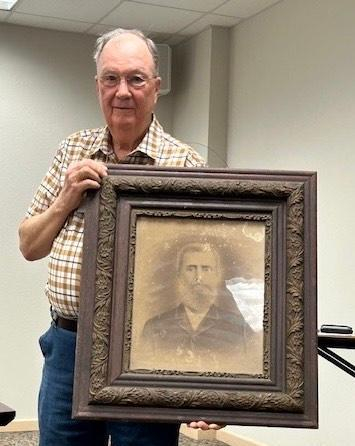
“In Uncle Ellis's bedroom there was an old trunk, filled mostly with old bedsheets, blankets, and clothes. But in the bottom I found some old letters. There were probably twenty or twenty-five, still in the envelopes, and some pictures. I thought to myself at the time, 'I'll just throw these away'. I didn't, though, and brought them back to our house and showed them to Judy. We decided to keep them for a while so we went to Walmart and bought some plastic sheet protectors so we could put the letters into a three-ring notebook. A few days later I went back to the old house and began working in the closet, where there was a big pile of old clothes, sheets, and towels. Underneath that I found another trunk. I pulled the trunk out and a large, framed picture was behind it,” Ramsey revealed, holding up the picture for the audience. “I have no idea who this man is, but he obviously was someone who was important to our family. There is no one left alive today who can identify the person but I certainly would have asked if I had known of its existence. Opening the trunk, I found more bed linens and clothes but there were more letters, this time a larger pile. I immediately thought 'We did not buy enough sheet protectors!' so we went back to Walmart and bought about ten more boxes. That would be five hundred sheet protectors, but in the end, even that wasn't enough. Throwing the letters away was no longer a consideration. I was hooked!”
“One day I went back to the old house and found another trunk under a table on the back porch. I opened it and it had a lot of my grandmother's purses inside. I went through all of them and didn't even find a nickel or a dime. But under the purses there was a pillow case tied at the four corners. I untied it and found more letters. These letters were older than the ones I had previously found. Those were mostly written in the 1930s and 40s. These went back to the early 1900s, the first being dated March 1, 1902. In the end, we found almost a thousand documents consisting mostly of letters, cards,and receipts. We have read them all and have learned some remarkable things. For example, in a letter dated January 24, 1912 from my great-grand mother Emma says she was sorry to hear of the baby being burned and was glad it was not worse. At that time the only baby in the house was my dad, w,ho was a little less than two years old. I had never heard of this. In an April 28, 1935 letter from my dad to his parents while he was working for the Civilian Conservation Corps in Jasper, he says that he just saw the best picture show he had ever seen, called “Imitation of Life.” I immediately ordered a copy of that movie and found out there had been a re-make of it in 1959 so I ordered it too. I didn't like the 1959 version but the original 1935 movie carries a timeless message and I recommend it,” Ramsey told.
“While the house was being built in 1944,” Ramsey continued, “my Uncle Ellis was driving a nail when a piece of metal flew up and hit him in the eye. At that time there was nothing that could be done so my grandmother put him to bed for a few days. He recovered but never regained the sight in his right eye. Within a year my grandmother's brother had bought him a glass eye and he wore it the rest of his life. In a letter dated October 14, 1944 my father asked his brother how his eye was doing. There were close to four hundred photographs among the documents but I don't know most of the people in them, but many I do.”
“We soon realized what a monumental task it was going to be to scan all of these documents in a way that would retain their originality, so I began looking for help. I first approached the East Texas Research Center at SFA but was told that they would retain the documents and that only the digital scans would be available for viewing. In August of 2017 I contacted The History Harvest at Humanities Texas in Austin. They scanned sixty-five pages over a period of two and a half hours for us but, at that rate, it was going to take too long to scan all that we had, given the fact that most of the letters were four or five pages long. Finally we contacted The History Center in Diboll, who had presented a program for TAGHS a few years prior. After several meetings with Jonathan Gerland, the director, we decided to donate most of the documents to them. They were going to do all of the scanning and they had a document retention policy which allowed the examination of the originals if a researcher desired. All of the documents are now available on The History Center's website at https://www.thehistorycenteronline.com/collections/category/esther-pennington-ramsey-correspondence-1895-1959.
“Finally, I can hardly describe my astonishment when, on September 22, 2018, I opened my Family Search account and a photograph popped up. It was the same photograph of my grandmother that I had found in one of those trunks. It was taken in 1902 but this copy has the inscription 'To my Aunt Betty from her niece, Esther.” You cannot contact a person who has posted something on Family Search directly but you can let them know you would like to communicate with them and they will respond if it suits them. I did so, and about a week later I heard from a woman in Hubbard, Texas named Kathleen Virginia Connor, who had posted the photo. I remembered having seen some references to Hubbard in some of the letters. We talked on the phone for over two hours and I made several discoveries on both my father and my mother's side of the family. She had a photograph of my grandmother four years before she was my grandmother that she had found in a box of her late father's thing in the barn. Our common ancestors are our great-great grandparents on my mother's side of the family. Kathleen and I became fast friends almost immediately and shared story after story of our family history. In December of that year, Judy and I drove over to Hubbard, which is between Corsicana and Waco, and met her and her mother. We took a lot of pictures of people I couldn't identify and she gave the the original photo of my grandmother with the inscription. In January of 2019 she and her mother came to Timpson for a visit and we took them down to The History Center where she saw the letters that were written by her great-grandmother Betty to my grandmother Esther,” Ramsey concluded.
The Timpson Area Genealogical Society meets at 2pm on the third Wednesday of each month in the meeting room of the Timpson Public Library on the corner of Austin and Bremond Streets in downtown Timpson. The TAGHS library is located within the Timpson Public Library and is open and staffed from 9AM until 5PM weekdays. Telephone 936-254-2966 and ask for the Genealogical Library.