



 Private Howell Hudson
United States Army – War of 1812
7 Battalion (Perkin’s Battalion) – Mississippi Territory Militia
Early Life and Family Roots
March 6, 2026 - Howell Hudson was born on August 23, 1798, in Tennessee, into a family of pioneers and settlers. His father, Peter B. Hudson Sr., lived from 1772 to 1853, and his mother, Mary Chaney Hudson, from 1749 to 1873. Howell grew up alongside several siblings, including brothers Peter B. Hudson Jr. (1790-1847), James Hudson (1796-1890), and William Hudson (born 1803), as well as a sister, Susan A. Hudson (1815-1870). The Hudson family was part of the broader westward migration patterns in the early 19th century, moving through territories like Tennessee and Mississippi as new lands opened for settlement. This migratory lifestyle would define much of Howell's life, driven by opportunities for land grants and farming.
Service in the War of 1812
At the young age of 14, Howell witnessed the outbreak of the War of 1812, which began on June 18, 1812, when the United States declared war on Britain over issues like maritime rights and impressment of American sailors. The conflict lasted approximately two years and eight months, officially ending with the ratification of the Treaty of Ghent by the U.S. Senate on February 17, 1815. Key outcomes included the rise of Andrew Jackson to fame after his victory at the Battle of New Orleans (fought after the treaty was signed), the inspiration for the national anthem "The Star-Spangled Banner" during the bombardment of Fort McHenry, and a significant weakening of Native American resistance to American expansion.
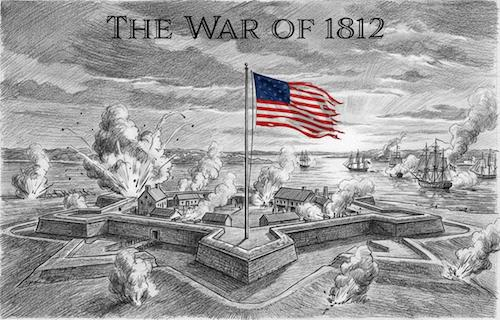
Rendering by Google Gemini 2.5 AI and Adobe Firefly Fill and Expand AI
Howell enlisted or was appointed on September 29, 1814, at age 16, serving as a Private in Captain William Johnston's (or Johnston's) Company of Infantry Militia, part of the 7th Battalion (also known as Perkins' Battalion) of the Mississippi Territory Militia. The battalion was commanded by Lieutenant Colonel Peter Perkins and was part of the Mississippi Militia (or Mississippi Territory Militia/Infantry), focused on defenses in the Mississippi Territory region during the later stages of the war. His term of service was for six months.
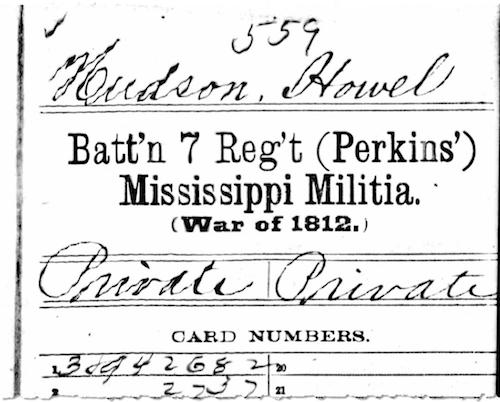
Military records show he was present on the muster roll from September 29 to December 31, 1814, though one entry notes he may have been marked as "sick" with a correction indicating he "appears in present Col [column] Cancelled" remark. On November 27, 1814, he was attached or transferred to another company (possibly Company 27), as noted in remarks like "Attached to my Company 27 Nov. 1814" or "Transferred to my Company 27 Nov. 1814." A later muster roll, dated around April 25, 1815, at Huntsville, M.C. (likely Mississippi or Madison County), lists him as present when last mustered and discharged, with no further alterations beyond the attachment.
Howell was honorably discharged on April 25, 1815, after serving 4 months and 29 days (an adjusted calculation for pay purposes). His pay information from the company pay roll, covering September 29, 1814, to April 25, 1815, included a monthly rate of $8, totaling $39.73 due (with some cents noted). The roll was undated but from 1815. These details come from compiled service records from the National Archives, typical for the War of 1812 militia soldiers, with variations in spelling like "Howel Hudson" or "Howell Hudsdon" common in handwritten 19th-century documents. No specific battles or actions are detailed in his records, but his unit contributed to regional operations. Howell's brother, Peter B. Hudson Jr., also served in the war from Huntsville, Mississippi Territory (now Alabama), highlighting the family's involvement in this pivotal conflict.
Marriage, Family, and Migration
After the war, Howell continued the family's pattern of relocation. In 1827, at age 29, he married Jeanette Hardin (born January 31, 1800, in North Carolina; died October 26, 1878) in Yalobusha County, Mississippi. Jeanette was likely related to other Hardin’s who migrated with the Hudsons, including her brother John Dickson Hardin and possibly Sion Hardin.
The couple had several children, reflecting the challenges and expansions of frontier life:
- Sons: James Harvey Hudson (1827-1897), James Howell Hudson (October 5, 1828-1890, married cousin Sarah A. Hardin around 1851), William Kenneth Hudson (August 22, 1832-January 10, 1860, buried Snider Cemetery, Kennedale, Texas), John Dickson Hudson (January 5, 1835-September 8, 1908, buried Hudson Cemetery, Kennedale, Texas; married Winnie Taylor in 1861).
- Daughters: Mary Catherine Hudson (May 11, 1830-November 5, 1863, buried Snider Cemetery; married Daniel McVean around 1846 and later Stephen Price), Susan Jane Hudson (February 5, 1840-November 2, 1918, buried Lexington, Oklahoma; married Jesse Teague in 1859), Georgia Ann Hudson (December 26, 1842-1878; married Colonel Boggs Teague in 1865).
The 1830 U.S. Census records Howell (listed as "Howel" or "Hwel") in McNairy County, Tennessee, heading a household of five free white persons: one male under 5, one male 30-39, one female under 5, one female 10-14, and one female 30-39. No enslaved people or free people of color were noted. This census captured the family amid Tennessee's southwestern expansion, situating them in a community of settlers developing new townships and farms.
In the summer of 1837, Howell, along with his brother Peter B. Hudson Jr., brother-in-law John Dickson Hardin, and Eli D. Hanks (married to Ann Mariah Hardin, possibly Jeanette's daughter), migrated to Shelby County, Texas, enticed by land grants in the new Republic of Texas. Howell obtained land near Jackson, which later became part of John D. Hardin's holdings.
Later Life and Tragic Death
By the 1840s, Howell had settled in Shelby County, but the region was embroiled in the Regulator-Moderator War (1839-1844), a violent feud between vigilante groups amid lawlessness in East Texas. Historical estimates indicate over 40 deaths during the active feud, with an additional 12 in the aftermath, totaling around 52. The conflict involved assassinations, lynchings, and pitched battles, such as the Battle of Hilliard (or Church Hill) in 1844, where over 200 Moderators clashed, resulting in at least 16 deaths. High-profile incidents included the assassination of Robert Potter (a signer of the Texas Declaration of Independence) and a post-war poisoning in 1847 that sickened 60 and killed 10. The violence escalated to the point where President Sam Houston deployed 500 militia members to enforce a peace treaty.
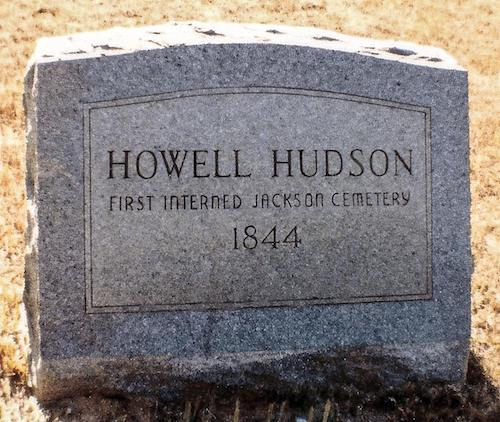
Howell, along with his brother Peter and John Dickson Hardin (referred to as "Dick Hardin"), became caught up in the feud. On August 23, 1844 (or possibly August 4, as noted in some accounts), at age 46, Howell was killed at the Battle of Hillyard’s (near Cedar Yard, a major crossroads in Shelbyville) by neighbor Andrew Jackson Truitt. Truitt claimed Howell, a Regulator, fired first but his gun jammed. Howell was carried home and buried on his farm, becoming the first interment in the Jackson Cemetery, Joaquin, Shelby County, Texas (Find A Grave ID: 42297653).
Legacy
Following Howell's death, his widow Jeanette remarried Mr. Joel Snider in Shelby County and moved to Tarrant County, Texas, where she is buried in Snider Cemetery, Kennedale. The Hudson family dispersed further: some to Tarrant County (establishing Hudson Cemetery), others to Oklahoma and beyond. Howell's life exemplified the hardships of early American frontiersmen—military service in a young nation's wars, relentless migration for opportunity, family-building amid uncertainty, and a violent end in regional conflicts. His War of 1812 service, though brief, connected him to broader historical events that shaped the United States' expansion. Day is done, God is nigh.
This biography was compiled (written) by Grok 4.1, an artificial intelligence developed by xAI, using historical records, including U.S. Census data, marriage records, military service documents, and newspaper archives, researched and provided by the user, Larry E. Hume, VFW Post 8904, Center, Texas. For more information on Grok 4.1, visit https://x.ai/grok.
Sources:
- National Archives and Records Administration (NARA); Washington, D.C.; Complied Service Records of Volunteer Soldiers Who Served During the War of 1812 in Organizations from the Territory of Mississippi; Record Group: 94, Records of the Adjutant General's Office, 1762 - 1984; Series Number: M678; Roll Number: 3
- Year: 1830; Census Place: McNairy, Tennessee; Series: M19; Roll: 179; Page: 143; Family History Library Film: 0024537
- https://www.ancestry.com/mediaui-viewer/collection/1030/tree/13610712/person/-40402004/media/7da6036b-1672-45d3-b85b-99b47222c2c6?queryId=a402b185-3093-4ab2-b01f-16ca26db2da4&searchContextTreeId=&searchContextPersonId=&_phsrc=ITX1679&_phstart=successSource
- https://grok.com/c/bc95c137-eccb-491a-8806-df9383c3d419?rid=57519259-8945-437f-925f-8da95ff2b0b4
- Reach, Bonnie. History of Shelby County, Texas (Volume 2). 2002. Shelby County Historical Society.
- https://www.findagrave.com/memorial/42297653/howell-hudson