



 Robert Earl Gorton Sayers
United States Army Air Forces - World War II
Second Lieutenant – 810 Army Air Forces Base Unit
June 1, 2026 - Robert was born on August 16, 1924, in Shreveport, Caddo Parish, Louisiana to Walter Willis Sayers (1888–1945) and Mary Janie Williams Sayers (1895–1993). He was the youngest surviving son in the family. His older brother, Walter Aaron Sayers (1919–2012), later served in World War II. An infant brother, Lou Thomas Sayers, had died in 1918.
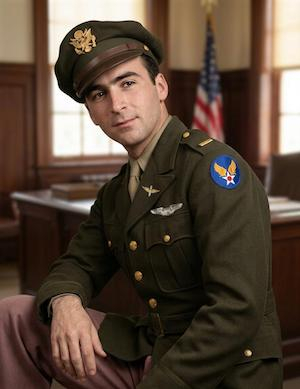
The family moved within East Texas and the Louisiana border region. In the 1930 U.S. Census, six-year-old Robert lived with his parents and brother Aaron in Precinct 6, Panola County, Texas, in territory west of the Logansport and Carthage road along the Sabine River. His father worked as Chief Engineer at a pumping oil plant, and the family rented a home and owned a radio. By the 1940 U.S. Census, the family had relocated to San Augustine, Texas, where Robert, then 15, was attending high school (second year) while living along Center Highway. His father worked as an Operating Engineer. The family had previously resided in rural Sabine County.
In 1943, at age 18, Robert was selected for military aviation training. Local newspapers reported on May 29, 1943, that he was one of six men from Draft Board 2 inducted at Fort Humbug who enlisted for aviation cadet training. Fort Humbug, formerly Fort Turnbull, was built by the Confederates to defend Shreveport, then the capital of Louisiana.

He enlisted on June 12, 1943, with serial number 38391478. By October 1943, he was training at the 333 College Training Detachment (Aircrew) at Peabody College in Nashville, Tennessee, where he was appointed student sergeant. During World War II, the 333 College Training Detachment (Aircrew) was hosted at Peabody College (now merged with Vanderbilt University) in Nashville, where it operated on campus during 1943 and 1944. The unit provided crucial academic and physical preparation for young Army Air Forces aviation cadets before they advanced to flight training, with trainees undergoing rigorous physical conditioning, ground school academics, and flight screening. Cadets regularly leased and occupied large sections of the Peabody Library for supervised, twice-daily study halls. As the massive initial backlog of aviation recruits decreased and the need for new pilots shifted, the War Department began phasing out college-based aircrew detachments, leading the Army to dissolve these programs with final training and transfers concluding by mid-1944.

AAF Aviation Officer Collar Insignia
On March 10, 1945, Robert was honorably discharged from enlisted service and commissioned as a Second Lieutenant with serial number 0841395. He served with the 810 Army Air Forces Base Unit at Laurinburg–Maxton Army Air Base in North Carolina. This unit, part of the I Troop Carrier Command, functioned as a Combat Crew Training School focused on preparing troop carrier crews. Training emphasized C-47 Skytrain operations, glider towing (such as the Waco CG-4A), and airborne assault tactics—skills critical for supporting major operations like the D-Day landings. The base supported both unit training and later individual replacement training. Robert was released from active duty on October 7, 1945 upon demobilization.
His father, Walter, died on July 23, 1945, in Conroe, Texas. At the time, Robert was listed as a Lieutenant stationed in North Carolina.
After returning home to Shreveport, Louisiana, Robert enrolled as a veteran student at Centenary College. In November 1945, he was among 25 local veterans who registered for special GI courses in history, mathematics, and English composition.
He remained active in aviation as a civilian pilot. Tragically, on May 26, 1946, during an air show in Natchitoches, Louisiana, Robert—flying a two-seat Piper Cub in a balloon-bursting contest—crashed while attempting a low-altitude maneuver. His close friend and passenger, Rowland “Rocky” Gies (also 22), was also killed. Robert’s mother and brother Aaron were among the spectators and witnessed the accident. Robert was killed instantly and Gies died shortly afterward. Robert was a student at Centenary College and a member of the Kappa Sigma fraternity at the time of his death.
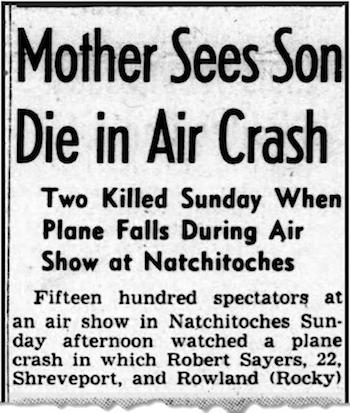
Funeral services were held on May 28, 1946, at Rose-Neath Funeral Chapel in Shreveport, conducted by Rev. Ira Peak of Queensborough Baptist Church. Robert was interred in the Johnson Cemetery, Joaquin, Texas near Logansport, Louisiana. He was survived by his mother, brother Aaron, and other family members.
Robert Earl Gorton Sayers’ life exemplified the experiences of many young men of the Greatest Generation: raised during economic hardship, called to serve in wartime aviation, and eager to resume civilian life and education—only for fate to intervene too soon at age 21. His story is preserved through census records, military documents, and contemporary newspaper accounts that capture both his service and the community’s loss. Day is done, God is nigh.
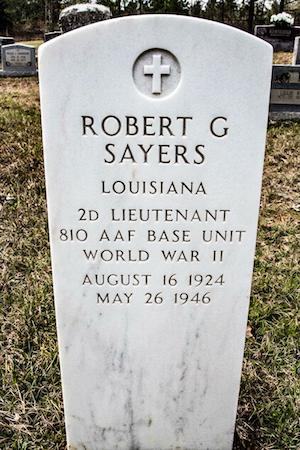
This story was written with creative support from SuperGrok by xAI. While Grok contributed ideas, dialogue, and scene drafts, the final narrative, characters, themes, and all revisions are the work of the author, Larry E. Hume, VFW Post 8904, Center, Texas, May 31, 2026.
Sources:
1. Year: 1930; Census Place: Precinct 6, Panola, Texas; Page: 14B; Enumeration District: 0015; FHL microfilm: 2342116
URL: https://www.ancestry.com/search/collections/6224/records/61528358
2. Year: 1940; Census Place: San Augustine, San Augustine, Texas; Roll: m-t0627-04132; Page: 17B; Enumeration District: 203-1 URL: https://www.ancestry.com/search/collections/2442/records/157831243
3. “Six Men Inducted By Draft Board 2”. The Shreveport Journal (Shreveport, Louisiana). May 29, 1943. Page 11.
URL: https://www.newspapers.com/image/600625846/?match=1&clipping_id=198568994
4. “Aviation Students”. The Times (Shreveport, Louisiana). October 22, 1943. Page 9.
URL: https://www.newspapers.com/image/209431359/?match=1&clipping_id=198569441
5. National Archives at Washington DC; Washington DC, USA; Applications for Headstones For U.S. Military Veterans, 1925-1941; NAID: 596118; Record Group Number: 92; Record Group Title: Records of the Office of the Quartermaster General
URL: https://www.ancestry.com/search/collections/2375/records/238548?tid=&pid=&queryId=117141e9-3f92-4545-a85e-b4c6c0aea4da&_phsrc=DcO16&_phstart=successSource :
6. The Shreveport Journal; Publication Date: 23 Jul 1945; Publication Place: Shreveport, Louisiana, USA; URL: https://www.newspapers.com/image/600631621/?article=14c94a4e-0a35-4abb-bb5f-72f8170d355d&focus=0.024666894,0.658315,0.15000583,0.746064&xid=3355
7. “25 Register for New Gl Course at Centenary College”. The Shreveport Journal (Shreveport, Louisiana). November 10, 1945. Page 10. URL: https://www.newspapers.com/image/600615593/?match=1&clipping_id=198569242
8. The Shreveport Journal; Publication Date: 27 May 1946; Publication Place: Shreveport, Louisiana, USA; URL: https://www.newspapers.com/image/600624789/?article=ab1de98d-8a22-4d2d-b4bf-f863e3ea48f0&xid=5575&terms=Mrs_Walter_W_Sayers